As we know, Leukaemia is a cancer that affects blood cells. In order to understand the disease better, we need to have a clear picture of how blood cells are made. Technically, our body has three main types of blood cells:
- Red blood cells. They carry oxygen to all the tissues in our body.
- White blood cells. They are involved in fighting infection. Neutrophils are a type of white blood cell that protect us from infection (they are the most common type of white blood cells).
- Platelets. They are involved in blood clotting.
To begin with, the new blood cells are made in our bone marrow. This is the soft spongy tissue that fills the centre of some of our bones. All the blood cells come from cells known as stem cells, and these cells split and develop into myeloid stem cells or lymphoid stem cells. As they start out as immature cells (blast cells), they then develop into different types of mature blood cells.
For example, lymphoid stem cells develop into lymphocytes (white blood cells that fight infection), and myeloid stem cells go on to form red blood cells, platelets and other types of white cells. As the blood cells develop, they move out of the bone marrow and into our bloodstream where they do different jobs, such as fighting infection (white cells), carrying oxygen (red cells) and clotting our blood so that we won’t lose too much blood (platelets). Simply put, our body is constantly producing enough cells to keep this process going.
In contrast, such blood cancers normally occur when something goes wrong with the development of blood cells in our bone marrow. In the case of people with leukaemia, their blast cells are produced but they do not develop properly. Instead, the immature blast cells build up in their bone marrow and the number of their healthy cells is reduced. As a result, they get sick because there are not sufficient amount of healthy blood cells to do their jobs in those people’s body.
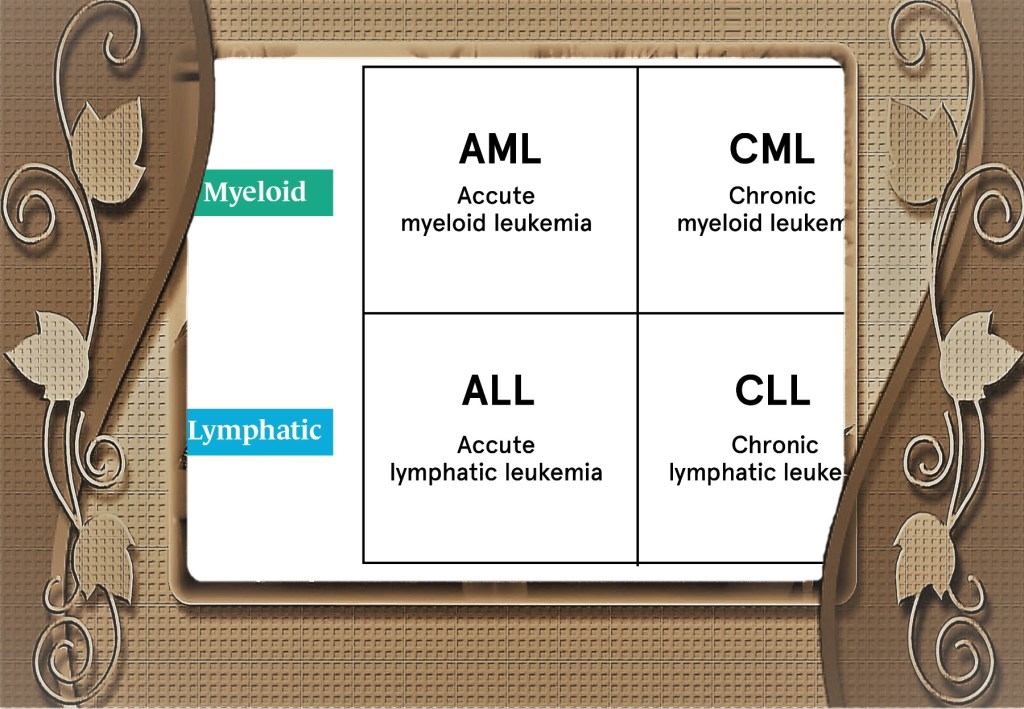
Perhaps, the types of leukaemia can be grouped based on how quickly the disease develops and gets worse. So far, doctors in many circumstances do not know precisely the causes of most cases of leukaemia. Yet, they do know that once the marrow cell undergoes a leukemic change, the leukaemia cells may grow and survive better than normal cells. The rate at which leukaemia progresses and how the cells replace the normal blood and marrow cells are different with each type of leukaemia. Having said that, leukaemia is either chronic (which usually gets worse slowly), or acute (which usually gets worse quickly).
1. Acute Myeloid Leukaemia (AML) & Acute Lymphoblastic Leukaemia (ALL)
– The original acute leukaemia cells go on to form roughly a trillion more leukaemia cells. These cells, additionally, are described as non-functional because they do not work like normal cells, in which they crowd out the normal cells in the marrow. Consequently, this causes a decrease in the number of new normal cells made in the marrow, which further results in anaemia, bleeding risk and infection risk.
2. Chronic Myeloid Leukaemia (CML)
– The leukaemia cells that occur in CML makes blood cells (red cells, white cells and platelets) function almost like normal cells. The number of red cells in this disease is usually less than normal; resulting in anaemia. However, many white cells and platelets sometimes are still made despite the white cells are nearly normal in how they work and continue to rise. Unfortunately, this can inflict serious problems if a patient does not get treatment (if the patient left untreated, the white cells can rise relatively higher which can slow down the blood flow and anaemia becomes severe).
3. Chronic Lymphocytic Leukaemia (CLL)
– Unlike the other types of leukaemia mentioned above, some patients with CLL may have disease that does not progress for a long time. The leukaemia cells that begin this disease makes too many lymphocytes that do not function properly. As these cells replace normal cells in the marrow and lymph nodes, they interfere with the work of normal lymphocytes which weakens the patient’s immune response. Perhaps, some people with CLL possess such slight changes that they appear in good health and may not need treatment for long periods of time. While other patients may require treatment at the time of diagnosis or soon after, the high number of leukaemia cells in the marrow may crowd out normal blood-forming cells and lead to a low red cell count (anaemia).


 The Dark Knight
You must be logged in to post a comment.